Q3: What is "oil bleeding"?
A:
"Oiling out" occurs in stearic acid during storage and transportation due to exposure to heat and pressure.Physical degradation, it is not a chemical leak. Typical signs observed by customers include:
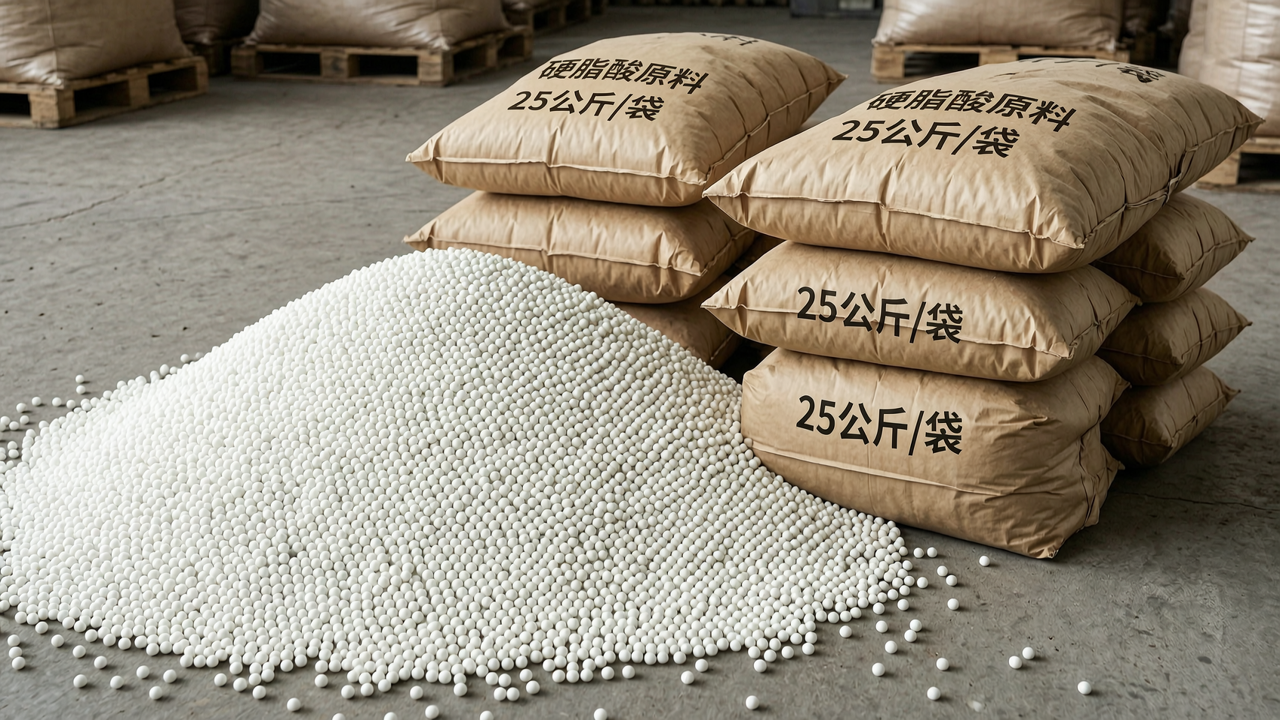
Packaging with oil leakageDark, oily stains appear on the surface of woven or paper bags, leaving a greasy feel when touched.
Grain "clumping": Originally loose granules or powder clump together, even forming a solid layer at the bottom of the packaging bag.
Liquefied Form: In extreme cases, free liquid oil may appear inside the bag and solidify into hard, irregular wax blocks after cooling.
Q4: Analysis of "Blooming" in Stearic Acid (Why Is It More Frequent in Summer?)
A:
The core conflict lies inExternal heat inputandinherent thermal sensitivity of the materialconflict:
Direct trigger — prolonged exposure to high temperatures: In a closed vehicle under direct summer sunlight, the temperature can reach60~70°C, while domestic stearic acid generally melts in the range of 54~57°C(Imported stearic acid, such as Sime Darby from Indonesia or椰树 from Malaysia, has a slightly higher melting point of approximately 58~65°C, but still cannot withstand the high temperatures inside cargo containers.)
Acceleration Factor — Compression Load: Even if the carriage temperature hasn't reached melting point, the static pressure from stacked cargo (with bottom layers bearing tons of weight) will significantlyLower the softening point of stearic acid(For every 1 MPa increase in pressure, the melting point drops by approximately 2-3°C), causing it to soften and creep at lower temperatures.
Co-factor: Hygroscopic DeliquescenceHigh summer humidity can cause packaging to absorb moisture. Water seeps between granules, disrupting crystal structures and increasing clumping, which worsens the "oiling out" effect.
Q5: What is the root cause of stearic acid "oiling out," and does it actually affect usability?
A:
It's a "physical phase change," not a "chemical spoilage."The chemical molecular structure of stearic acid (C₁₇H₃₅COOH) remains unchanged, with no oxidation, decomposition, or acid-base reactions occurring. The so-called "oiling out" is merely the process of solid crystals melting due to heat and deforming under pressure before re-solidifying.
The impact on usage depends on the situation.:
Without compromising core chemical performance: ForRubber additives, plastic lubricants, and daily chemical productsFor the vast majority of downstream applications, stearic acid is used as a processing aid and must be heated and melted in a reactor before use. Caking or "bleeding" does not alter its active ingredient content or key metrics such as acid value and saponification value.
Impact on Physical Operability: Only forRequires direct dry blending.processes (such as certain powder coating or direct compression processes) result inDifficult to load materialsHowever, this is an operational convenience issue, not a product quality problem. After crushing and sieving, it can be reused without being scrapped.
Guiz xiao